Whether you need a monsoon shed in Mumbai, a construction site shed in Maharashtra or a temporary warehouse in Gujarat, the right contractor comes down to 12 checks: comparable projects, GSTIN, an in-house erection crew, client references, a site visit, written specifications, wind and rain design, like-for-like quotations, safety and insurance, permission support, lead time and dismantling support. Check below names the proof to ask for, so you can shortlist with confidence.
How Do You Choose a Temporary Shed Contractor in India?
Check three areas: credibility, design and quotation, and support through removal. The 12 points cover experience, registration, crew, references, site visit, specifications, weather design, quotations, safety, permissions, lead time and dismantling, each with the proof to request.
Proof beats claims. Work orders, a GSTIN you can verify and a completed shed you can visit tell you more than a brochure.
Written specifications set quality. Frame, cover grade, GSM and fixings belong in the quotation, so every contractor prices the same shed.
Site design comes first. A contractor who visits your site designs for its wind, rain and ground.
Support runs to removal. Safety, permissions, lead time and dismantling decide how smoothly the hire ends.
Ready to compare contractors? |
How Do You Check a Temporary Shed Contractor’s Credibility?
Credibility has four proofs: work orders for comparable projects, a GSTIN you can check online, a named in-house erection crew and client references. Shortlist the contractors who share all four, then request a written quotation from each.
Example: A plant manager in Bhiwandi comparing temporary warehouse on hire quotations can cut a list of five to two with one round of calls, simply by asking each contractor for work orders and a GSTIN.
1. Match Experience to Your Shed Type and Site
Comparable projects matter more than years in business. A cement-storage shed, a machinery shed and a monsoon cover for open-yard stock call for different frames, spans and tie-down. Institutional buyers screen the same way: a July 2024 quotation notice from the BMC Hydraulic Engineer’s Department asked bidders for work-order copies of at least one shed or temporary shed job completed in the last seven years for a government body, semi-government body, public sector undertaking or public limited company.
Ask for: work orders or completion letters for two projects close to your shed type, size and city.
2. Verify the GSTIN and Business Registration
A GSTIN (Goods and Services Tax Identification Number) can be checked in minutes. Enter it in Search Taxpayer on the GST portal, which is open to any visitor, to see the legal name, registration date, status and principal place of business, then match them to the quotation and invoice. If the contractor holds an Udyam registration (the government’s MSME registration), verify the 19-digit number on the Udyam portal.
Ask for: GSTIN, PAN and registered office address.
3. Ask Who Erects the Shed
Erection decides how the shed performs. Ask whether the contractor’s own crew erects the structure or sub-contracts it, and who supervises on site. An in-house crew keeps one team accountable from delivery to handover.
Ask for: the supervisor’s name, the crew size and the number of similar erections the crew has completed.
4. Speak to Past Clients or Visit a Completed Shed
A short call with a past client confirms delivery, workmanship and after-sales response. If a completed shed is near you, visit it and check cover tension, joints, anchoring and drainage after a monsoon season.
Ask for: two client contacts from recent projects, one with a shed that has been in service through a monsoon.
What Should the Contractor’s Design and Quotation Cover?
A reliable quotation follows a site visit and states the shed’s dimensions, frame, cover grade, fixings, weather design and exclusions in writing. These four checks let you compare contractors on the same specification instead of the same total.
Example: Two quotations for a construction site temporary shed of the same size can look alike on paper, yet one specifies a 120 GSM cover and the other a 250 GSM cover. The specification line explains the gap, and the written quotation is where you find it.
5. Request a Site Visit Before the Quotation
A site visit turns assumptions into measurements. The contractor checks usable area, ground condition, access for delivery vehicles, power, drainage and exposure to wind, then designs the layout around them.
Ask for: a visit date, a site measurement sheet and the layout the quotation is based on.
6. Get Materials and Specifications in Writing
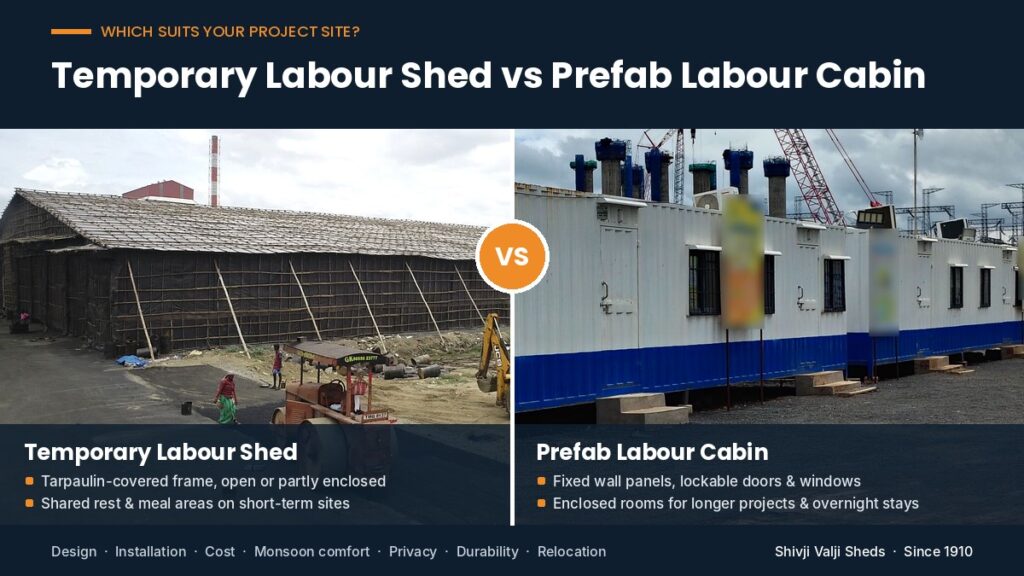
The quotation should name the frame (MS pipe or truss, GI pipe, bamboo or wooden ballies), the cover and the fixings. Bamboo and wooden frames suit spans up to about 9 m, while fabricated MS trusses reach 15 to 28 m with clear, column-free spans. HDPE (high-density polyethylene) laminated tarpaulin is the default cover, with most industrial grades at 120 to 250 GSM (grams per square metre) and PVC-coated fabric for heavier duty.
A contractor with a full range, such as a monsoon or tarpaulin shed, a hybrid shed or an MS steel shed, can recommend the fit for your use instead of one product for every site. See how tarpaulin, PVC, GI, MS frame and hybrid compare before you decide.
Ask for: frame material and section sizes, cover type with GSM, and the fixing and tie-down method.
7. Ask for the Wind, Rain and Ground Design Basis
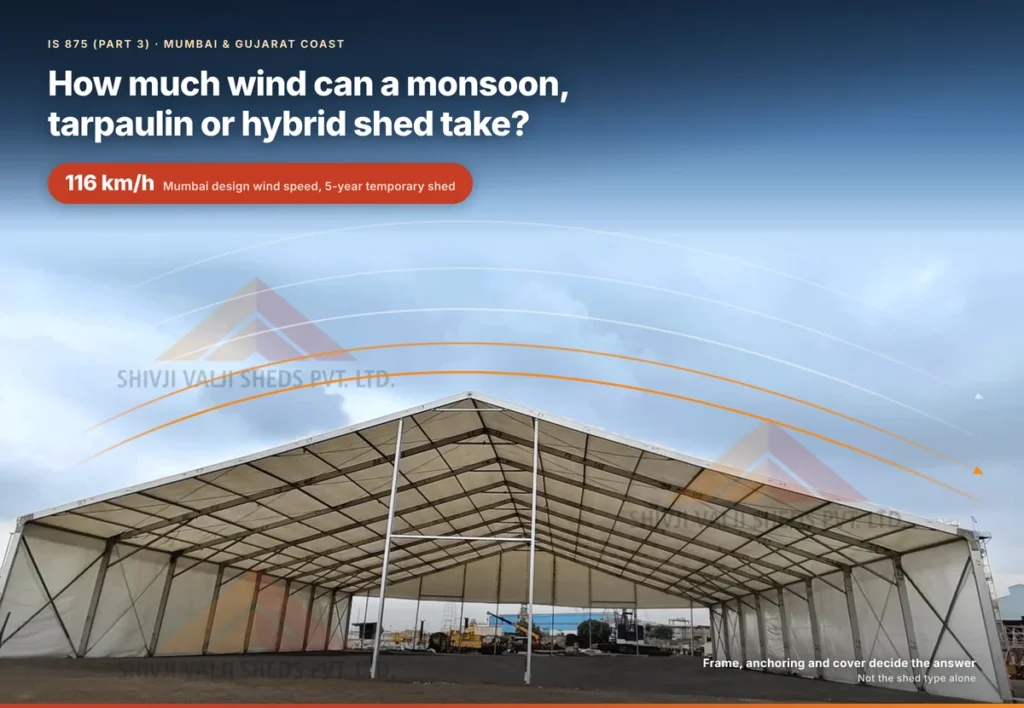
A shed performs to the weather it is designed for. Temporary sheds are designed to a 5-year life with a lower wind load than permanent buildings, and basic wind speeds across India run from 33 to 55 m/s under IS 875 (Part 3), the Bureau of Indian Standards code for wind loads. Coastal and open-terrain sites, such as Mumbai and the Gujarat coast, are assessed separately from sites inside built-up estates, so a contractor should state the wind speed, anchoring and drainage planned for your location.
Ask for: the design wind speed, anchor type and weight, roof drainage plan and bracing for your site.
8. Compare Quotations on the Same Scope
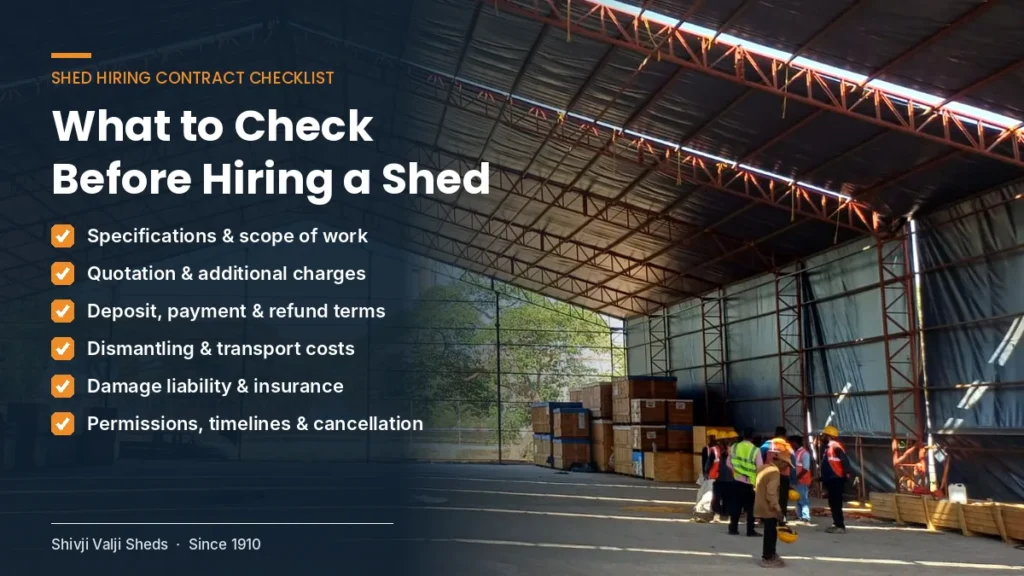
Ask every contractor to quote the same area, shed type, hiring period and services. List what each includes: transport, unloading, erection, equipment, dismantling and taxes. A one-page scope matrix with inclusions and exclusions side by side makes totals comparable. For what shapes hire charges, read temporary shed rental price in India.
Ask for: an itemised quotation with inclusions, exclusions and a validity period.
Want your site assessed first? |
What Support Should You Expect From Erection to Removal?
Expect safe erection, documented compliance support, a firm schedule and a clear removal plan. These four checks, safety and insurance, permissions, lead time and dismantling, keep the shed useful for the whole project and closed out cleanly at the end.
Example: A construction site shed moves as the work moves. Agreeing the dismantling, loading and relocation plan before erection means the shed follows the project to its next phase on schedule.
9. Confirm Safety Practices and Insurance
Erection involves working at height with long steel sections and tarpaulin under tension. Ask how the crew protects itself and your site, and which insurance covers the crew and third-party damage. Where fire safety matters, ask for a fire-retardant cover grade, since PVC-coated fabrics are available in fire-retardant grades.
Ask for: the safety method, insurance details and the cover’s fire-retardant specification where needed.
10. Check Permission and Documentation Support
Permission requirements depend on location, use and the local authority. A contractor who supplies drawings, specifications and structural details speeds up the approval stage. Read the temporary shed permission process in India before you apply.
Ask for: drawings and specifications in the format your authority or client requires, and who submits the application.
11. Confirm Lead Time and Capacity
Confirm dates early for monsoon-season projects. For a monsoon shed on hire in Mumbai or elsewhere in Maharashtra, ask for the delivery date, the erection schedule and the number of crews assigned to your project size, plus how schedule changes are communicated. A contractor with multiple erection teams can hold dates when site conditions shift.
Ask for: a written delivery and erection schedule and the crew size assigned.
12. Plan Dismantling, Relocation and After-Sales Support
Removal is part of the job. Confirm who dismantles, loads and transports the shed, and whether the shed is dismantable and relocatable so it can move to your next site. Agree how repairs are handled during the hire, and name one contact for site issues with an expected response time.
Ask for: the removal scope, relocation terms, a repair contact and the response time in writing.
Why Choose Shivji Valji as Your Temporary Shed Contractor?
Shivji Valji is a temporary shed contractor, supplier and erector, established in 1910. The team assesses your site, plans the structure, supplies or rents the shed, erects it with in-house crews and dismantles it when your project ends.
The range covers tarpaulin, monsoon, hybrid, dome, German hanger, MS steel, GI sheet and PEB sheds, so the recommendation follows your use, not a single product. You can hire a shed for a defined period or buy it for repeat use, and the temporary shed pan India service reaches construction, industrial and storage sites across more than 20 industries.
Need a temporary shed contractor? |
FAQs
1. How do you choose a temporary shed contractor in India?
Choose the contractor who proves experience, registration and capability in writing. Check comparable projects, a verifiable GSTIN, an in-house erection crew and a site visit before quoting, then compare itemised quotations, safety cover, permission support and removal terms. Shortlist the one that answers every point with documents.
2. How do you verify that a temporary shed contractor is genuine?
Verify the GSTIN on the GST portal and match the legal name and address to the quotation. Ask for work orders from comparable projects, then call a past client or visit a completed shed. A genuine contractor shares PAN, registered address and insurance details on request.
3. How many quotations should you compare?
Compare at least three quotations. Each should cover the same area, shed type, hiring period and services, with inclusions and exclusions listed, so the totals reflect the same scope.
4. Should you choose a temporary shed contractor, dealer or supplier?
Choose a contractor when you want one team accountable for site assessment, supply, erection and removal under one agreement. Choose a dealer or supplier when you need materials only and have your own erection crew. If you search for temporary shed dealers near me, ask each one whether erection and removal are included in the quotation.
5. Can a temporary shed contractor provide a shed on hire as well as for purchase?
Yes, a full-service contractor offers both. A temporary shed on hire or on rent suits short or changing needs, and purchase suits repeat use, so ask for both quotations side by side and decide on project duration and reuse.