
Temporary shed rental price in India runs Rs 15 to Rs 40 per sq ft on published supplier listings, but that figure alone does not tell you what you will pay. Two quotes with the same headline rate can land four times apart on the final invoice. The difference comes down to whether the rate covers the full contract term or each month. One missing line item, most often dismantling, can make a costlier quote look 20% cheaper. This guide covers what the rate includes, the 8 factors that move it, how to calculate total contract cost, and the charges to price in before you sign.
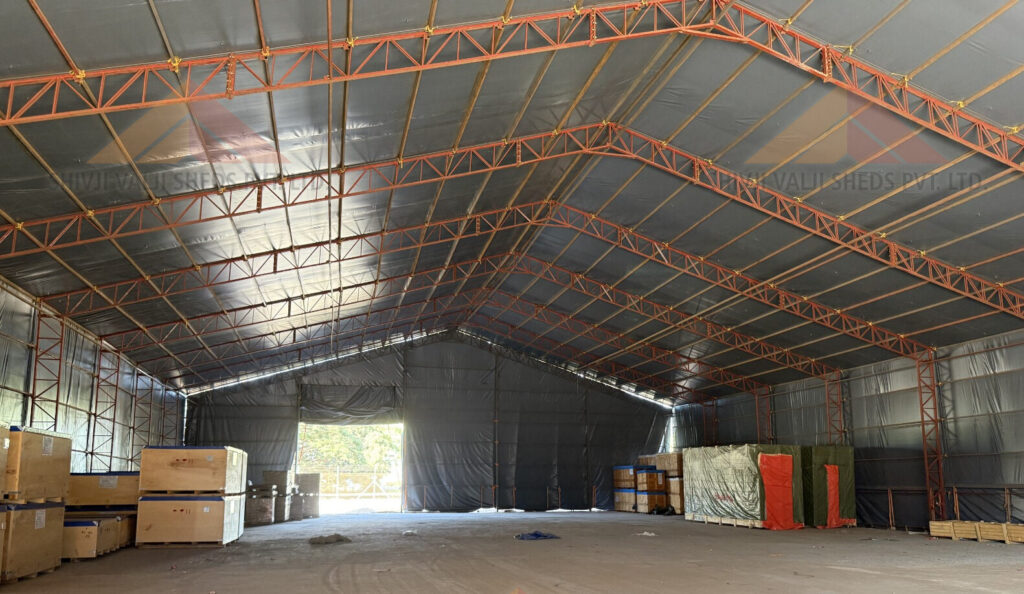
Temporary Shed Rental Price in India: The Published Rate Band
Temporary shed rental rates published on Indian supplier listings run between Rs 15 and Rs 40 per square foot as of Oct 2026. Bamboo and tarpaulin sheds sit at the lower end, MS truss and clear-span structures at the upper end, and the rate covers material, erection, and dismantling rather than space alone.
Public listings on IndiaMART and supplier websites give the following picture across structure types.
| Structure type | Listed rate band | Where the rate sits |
| Steel prefab temporary shed on hire | Rs 15 to Rs 20 per sq ft | Lower band, larger areas |
| Temporary warehouse and storage structure | Rs 15 to Rs 30 per sq ft | Mid band, most common enquiry |
| Temporary industrial shed, monthly basis | Rs 20 to Rs 25 per sq ft | Mid band |
| Waterproof tarpaulin and monsoon shed | Rs 20 to Rs 40 per sq ft | Upper band, seasonal contracts |
Rate bands are drawn from public supplier listings read in August 2026. They are indicative of the market rather than a quotation, and they exclude GST.
One caution carries more weight than the number itself. Listings rarely state whether the rate applies to the full contract term or to each month of occupation. A quote of Rs 25 per sq ft for a four-month monsoon contract and a quote of Rs 25 per sq ft per month describe the same structure at four times the price. Pin the basis down before comparing anything.
What Does the Per Square Foot Rental Rate Include?
A temporary shed rental rate covers the full turnkey scope: structural material, waterproof covering, transport to site, skilled erection labour, maintenance during the contract, and dismantling with material removal at contract end. Unlike warehouse rent, the rate buys a structure on your own premises rather than leased floor space.
Scope is the reason two per-square-foot numbers are not comparable until you read them. A standard rental contract carries these line items inside the rate.
- Structural Material: Ballies, bamboo, MS pipe, or fabricated truss members, supplied for the contract term and returned at the end.
- Covering Material: HDPE laminated tarpaulin, LDPE ridge liner, or PVC coated fabric, specified against the exposure the site carries.
- Transport: Inward movement of material to the site and outward movement at contract close.
- Erection Labour: Supervisors and skilled crew deployed for the build window agreed at the quotation stage.
- Maintenance During Contract: Attending to cover slippage, tie-down slack, and storm damage while the shed is in use.
- Dismantling & Site Clearance: Removal of all material, with the site returned to its original condition.
Which Factors Change the Temporary Shed Rental Price?
Eight variables move temporary shed rental rates: covered area, clear span, frame type, cover grade, eave height, contract duration, site location, and season of booking. Area and span carry the most weight, and monsoon-season bookings made late carry the steepest premium.
Each factor moves the rate in a predictable direction, which makes the final number easier to anticipate before an enquiry goes out.
- Covered Area: Larger areas lower the per-square-foot rate. Supplier listings commonly set minimum order quantities of 4,000 to 10,000 square feet, below which mobilisation cost spreads across too little area.
- Clear Span: Span drives frame cost more than any other technical variable. A bamboo and ballie frame with intermediate posts costs least, while a pillarless MS truss holding 15 to 28 metres clear costs most.
- Frame Type: Bamboo and wooden ballie frames sit at the bottom of the band, MS pipe frames in the middle, and fabricated MS truss and space-frame structures at the top.
- Cover Grade: Cover is quoted in GSM. Heavier HDPE laminate, double-layer roofs, LDPE ridge liners, and fire-retardant PVC grades each add to the rate.
- Eave Height: Height raises material quantity on columns and side cladding, and raises wind load on the frame, so forklift or racking clearance costs more per square foot.
- Contract Duration: Longer contracts spread erection and dismantling cost across more time and lower the effective monthly rate. Very short contracts do the opposite.
- Site Location: Transport distance, local labour rates, and wind zone all move the rate. Coastal sites require heavier anchoring and bracing under IS 875 (Part 3).
- Season of Booking: Demand concentrates before the rains. Enquiries placed in April and early May get better rates and better crew availability than those placed in June.
How Is Temporary Shed Rental Cost Calculated?
Temporary shed rental cost is calculated as covered area in square feet multiplied by the agreed rate per square foot, applied over the contract term, plus GST and any site-specific additions. Confirm whether the rate is a term rate or a monthly rate before applying the formula.
The formula is short. The basis is what people get wrong.
Total contract value = Covered area (sq ft) x Rate (Rs per sq ft) x Rate basis multiplier
The example below applies that formula to a 10,000 sq ft shed quoted at Rs 25 per sq ft for a four-month monsoon contract.
| Rate basis stated in quote | Calculation | Total contract value | Effective monthly cost |
| Rs 25 per sq ft for the full term | 10,000 x 25 | Rs 2,50,000 | Rs 62,500 |
| Rs 25 per sq ft per month | 10,000 x 25 x 4 | Rs 10,00,000 | Rs 2,50,000 |
Same structure, same headline number, four times the invoice. This single ambiguity causes more disputed comparisons than every technical variable combined.
Two further steps complete the calculation:
- Add GST: Applied on the contract value at the prevailing rate for the service.
- Add Site-Specific Work: Quoted separately from the rate, and covered in the exclusions section below.
Convert the result to a per-square-foot-per-month figure before comparing it against any other option. On the term-rate example above, Rs 2,50,000 across four months on 10,000 square feet works out to roughly Rs 6.25 per square foot per month.
Temporary Shed Rent vs Warehouse Rent vs Permanent Shed
Three different numbers circulate under the phrase shed rent in India. A temporary shed on hire runs Rs 15 to Rs 40 per sq ft on published listings, leased warehouse space runs Rs 5 to Rs 70 per sq ft per month depending on city and grade, and a permanent PEB shed is a capital cost of Rs 1,200 to Rs 2,500 per sq ft.
These are three separate commercial decisions, and comparing across them without converting to a common basis produces the wrong answer.
| Option | What you are paying for | Published range | Nature of spend |
| Temporary shed on hire | A structure erected on your own premises | Rs 15 to Rs 40 per sq ft | Operating cost, seasonal |
| Leased warehouse space | Floor space in someone else's building | Rs 5 to Rs 70 per sq ft per month | Operating cost, multi-year lease |
| Permanent PEB shed | An owned asset with foundations | Rs 1,200 to Rs 2,500 per sq ft | Capital cost, one time |
Warehouse rental rates in India span roughly Rs 5 to Rs 70 per sq ft per month, with Mumbai and Bengaluru at the top of the range and Tier 3 cities at the bottom. Against that, a temporary shed converting to roughly Rs 6 per square foot per month on a four-month term looks structurally different, though it delivers cover rather than a serviced Grade A facility.
Permanent construction sits in another category again. PEB industrial shed costs in India are quoted between Rs 1,200 and Rs 2,500 per sq ft, against Rs 2,200 to Rs 3,500 per sq ft for traditional RCC. That is capital locked into an asset with foundations, drawings, and a multi-month build.
Three questions decide which column applies:
- Material Stays On Site: If the stock needs to stay on your own premises near the process, a temporary shed applies.
- Serviced Floor Space Needed: If you need dock levellers and fire systems for years, leased warehouse space applies.
- Permanent Covered Area: If you need covered area you will own for decades, PEB or RCC construction applies.
Where the requirement is permanent covered area rather than seasonal cover, the PEB shed and GI shed route applies instead of a rental contract.
Which Costs Sit Outside the Quoted Rental Rate?
Costs commonly excluded from a temporary shed rental rate include GST, ground levelling and civil preparation, flooring or plinth work, lighting and electrical fitting, insurance of stored goods, and extension charges when the contract runs past the agreed term.
Budget for these separately. Each is a routine addition rather than an exception.
- GST: Applied on the contract value at the prevailing rate for the service.
- Ground Preparation: Levelling, murum filling, or hard-standing where the existing surface cannot take the frame.
- Flooring & Plinth: The rate covers the structure, not the floor underneath it.
- Lighting & Electricals: Fittings, wiring, and distribution inside the covered area.
- Insurance of Stored Goods: The contractor insures the structure while the client insures the contents.
- Extension Charges: Pro-rata rates applied when a monsoon runs long or dispatch slips past the agreed term.
- Repeat Mobilisation: Additional visits required for phased erection across multiple bays.
Why Choose Shivji Valji Sheds Pvt. Ltd. for Temporary Shed Rental?
A rental rate is only useful when the scope behind it is written down. At Shivji Valji Sheds Pvt. Ltd., we quote against a site survey rather than a headline per-square-foot figure, so the basis, inclusions, and exclusions are visible before a contract is signed.
What we bring to your temporary shed requirement:
- Contracting Since 1910: Over a century of pricing, supplying, and erecting temporary structures across Indian industry.
- Line-Itemised Quotations: Material, transport, erection, maintenance, and dismantling are stated separately rather than bundled into one figure.
- Written Rate Basis: Every quotation states whether the rate applies to the term or to each month, so comparison is straightforward.
- Site Survey Before Quoting: Ground condition, access, and wind exposure are assessed before a rate is issued.
- Turnkey Scope: Erection, in-season maintenance, and dismantling are handled by our own team rather than subcontracted.
- Available on Hire or Contract: Sheds can be taken for a season or a project period, avoiding capital investment for temporary cover.
| Get a line-itemised quotation based on your area, span, and site conditionsRequest a site survey today! |
FAQs
1. What is the minimum area for renting a temporary shed in India?
Supplier listings commonly set minimum order quantities of 4,000 to 10,000 square feet. Below that threshold, transport and crew mobilisation spread across too little area, so the effective per-square-foot rate rises steeply. Small requirements are usually better served by an outright purchase of covers.
2. Is temporary shed rent charged monthly or for the full season?
Both models exist in the market, which is why comparing headline rates is unreliable. Monsoon contracts are commonly written for a fixed four-month term, while industrial storage contracts are often written monthly. Ask every supplier to state the basis in writing on the quotation.
3. Does the rental rate include erection and dismantling?
A turnkey rental rate includes transport, erection labour, maintenance during the contract, and dismantling at the end. Not every quotation carries all four. Dismantling is the line most frequently excluded, so confirm it is priced in before comparing one rate against another.
4. Is renting a temporary shed cheaper than leasing warehouse space?
Converted to a common basis, a temporary shed on a seasonal contract usually works out lower per square foot per month than leased warehouse space in metro clusters. The two are not equivalent, though. A shed gives cover on your own premises, while a lease gives serviced floor space with utilities, fire systems, and dock infrastructure.
5. When should a temporary shed be booked for the monsoon?
Book in April or early May. India's southwest monsoon typically reaches Kerala around 1 June and covers the country over the following weeks, and material and crews across the market are committed well before that. Late bookings pay more and get narrower erection windows.
| Rate basis stated in quote | Calculation | Total contract value | Effective monthly cost |
| Rs 25 per sq ft for the full term | 10,000 x 25 | Rs 2,50,000 | Rs 62,500 |
| Rs 25 per sq ft per month | 10,000 x 25 x 4 | Rs 10,00,000 | Rs 2,50,000 |
Same structure, same headline number, four times the invoice. This single ambiguity causes more disputed comparisons than every technical variable combined.
Two further steps complete the calculation:
- Add GST: Applied on the contract value at the prevailing rate for the service.
- Add Site-Specific Work: Quoted separately from the rate, and covered in the exclusions section below.
Convert the result to a per-square-foot-per-month figure before comparing it against any other option. On the term-rate example above, Rs 2,50,000 across four months on 10,000 square feet works out to roughly Rs 6.25 per square foot per month.
Temporary Shed Rent vs Warehouse Rent vs Permanent Shed
Three different numbers circulate under the phrase shed rent in India. A temporary shed on hire runs Rs 15 to Rs 40 per sq ft on published listings, leased warehouse space runs Rs 5 to Rs 70 per sq ft per month depending on city and grade, and a permanent PEB shed is a capital cost of Rs 1,200 to Rs 2,500 per sq ft.
These are three separate commercial decisions, and comparing across them without converting to a common basis produces the wrong answer.
| Option | What you are paying for | Published range | Nature of spend |
| Temporary shed on hire | A structure erected on your own premises | Rs 15 to Rs 40 per sq ft | Operating cost, seasonal |
| Leased warehouse space | Floor space in someone else's building | Rs 5 to Rs 70 per sq ft per month | Operating cost, multi-year lease |
| Permanent PEB shed | An owned asset with foundations | Rs 1,200 to Rs 2,500 per sq ft | Capital cost, one time |
Warehouse rental rates in India span roughly Rs 5 to Rs 70 per sq ft per month, with Mumbai and Bengaluru at the top of the range and Tier 3 cities at the bottom. Against that, a temporary shed converting to roughly Rs 6 per square foot per month on a four-month term looks structurally different, though it delivers cover rather than a serviced Grade A facility.
Permanent construction sits in another category again. PEB industrial shed costs in India are quoted between Rs 1,200 and Rs 2,500 per sq ft, against Rs 2,200 to Rs 3,500 per sq ft for traditional RCC. That is capital locked into an asset with foundations, drawings, and a multi-month build.
Three questions decide which column applies:
- Material Stays On Site: If the stock needs to stay on your own premises near the process, a temporary shed applies.
- Serviced Floor Space Needed: If you need dock levellers and fire systems for years, leased warehouse space applies.
- Permanent Covered Area: If you need covered area you will own for decades, PEB or RCC construction applies.
Where the requirement is permanent covered area rather than seasonal cover, the PEB shed and GI shed route applies instead of a rental contract.
Which Costs Sit Outside the Quoted Rental Rate?
Costs commonly excluded from a temporary shed rental rate include GST, ground levelling and civil preparation, flooring or plinth work, lighting and electrical fitting, insurance of stored goods, and extension charges when the contract runs past the agreed term.
Budget for these separately. Each is a routine addition rather than an exception.
- GST: Applied on the contract value at the prevailing rate for the service.
- Ground Preparation: Levelling, murum filling, or hard-standing where the existing surface cannot take the frame.
- Flooring & Plinth: The rate covers the structure, not the floor underneath it.
- Lighting & Electricals: Fittings, wiring, and distribution inside the covered area.
- Insurance of Stored Goods: The contractor insures the structure while the client insures the contents.
- Extension Charges: Pro-rata rates applied when a monsoon runs long or dispatch slips past the agreed term.
- Repeat Mobilisation: Additional visits required for phased erection across multiple bays.
Two items deserve specific attention. Ground preparation is the most common surprise on yards that have never carried a structure, and extension charges are the most common surprise in a late monsoon. Ask for both to be priced at the quotation stage rather than negotiated mid-contract.
Understanding the structure behind the rate makes each of these easier to scope. Our guide to what a monsoon shed is covers the frame types, materials, and spans referenced throughout this article, and our temporary warehouse and storage pages set out the sector requirements that change a specification.
Why Choose Shivji Valji Sheds Pvt. Ltd. for Temporary Shed Rental?
A rental rate is only useful when the scope behind it is written down. At Shivji Valji Sheds Pvt. Ltd., we quote against a site survey rather than a headline per-square-foot figure, so the basis, inclusions, and exclusions are visible before a contract is signed.
What we bring to your temporary shed requirement:
- Contracting Since 1910: Over a century of pricing, supplying, and erecting temporary structures across Indian industry.
- Line-Itemised Quotations: Material, transport, erection, maintenance, and dismantling are stated separately rather than bundled into one figure.
- Written Rate Basis: Every quotation states whether the rate applies to the term or to each month, so comparison is straightforward.
- Site Survey Before Quoting: Ground condition, access, and wind exposure are assessed before a rate is issued.
- Turnkey Scope: Erection, in-season maintenance, and dismantling are handled by our own team rather than subcontracted.
- Available on Hire or Contract: Sheds can be taken for a season or a project period, avoiding capital investment for temporary cover.
| Get a line-itemised quotation based on your area, span, and site conditionsRequest a site survey today! |
FAQs
1. What is the minimum area for renting a temporary shed in India?
Supplier listings commonly set minimum order quantities of 4,000 to 10,000 square feet. Below that threshold, transport and crew mobilisation spread across too little area, so the effective per-square-foot rate rises steeply. Small requirements are usually better served by an outright purchase of covers.
2. Is temporary shed rent charged monthly or for the full season?
Both models exist in the market, which is why comparing headline rates is unreliable. Monsoon contracts are commonly written for a fixed four-month term, while industrial storage contracts are often written monthly. Ask every supplier to state the basis in writing on the quotation.
3. Does the rental rate include erection and dismantling?
A turnkey rental rate includes transport, erection labour, maintenance during the contract, and dismantling at the end. Not every quotation carries all four. Dismantling is the line most frequently excluded, so confirm it is priced in before comparing one rate against another.
4. Is renting a temporary shed cheaper than leasing warehouse space?
Converted to a common basis, a temporary shed on a seasonal contract usually works out lower per square foot per month than leased warehouse space in metro clusters. The two are not equivalent, though. A shed gives cover on your own premises, while a lease gives serviced floor space with utilities, fire systems, and dock infrastructure.
5. When should a temporary shed be booked for the monsoon?
Book in April or early May. India's southwest monsoon typically reaches Kerala around 1 June and covers the country over the following weeks, and material and crews across the market are committed well before that. Late bookings pay more and get narrower erection windows.