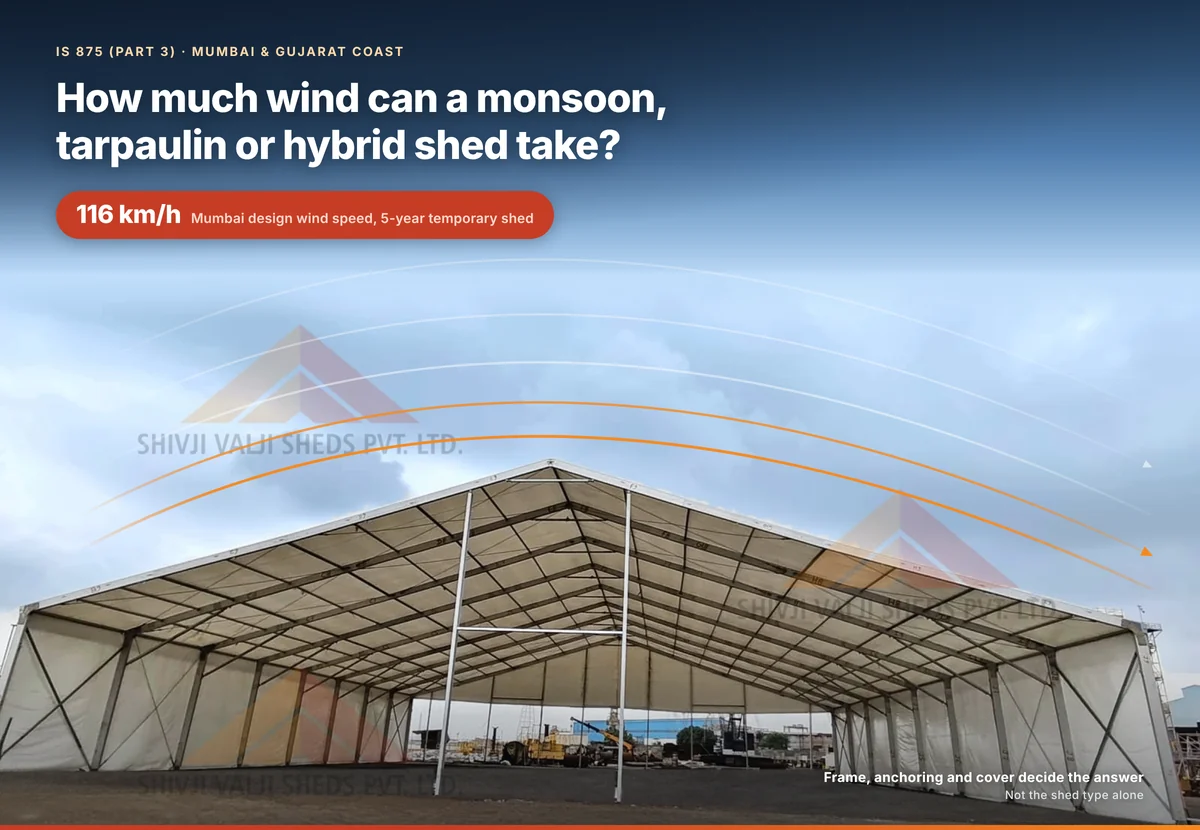
On the Mumbai coast, a temporary shed is designed for winds of about 116 km/h, and parts of the Gujarat coast are higher. Frame, anchoring and cover decide how a monsoon or tarpaulin shed or a hybrid shed performs against that figure. It comes from IS 875 (Part 3), the Bureau of Indian Standards code for wind loads, and recent storms such as Cyclone Tauktae, which gusted to 114 km/h in Colaba, came close. This guide shows what that means for your site and what to confirm before you order.
How Much Wind Can a Temporary Shed Take on the Mumbai and Gujarat Coast?
A temporary shed on the Mumbai coast is designed for about 116 km/h (32 m/s). IS 875 (Part 3) sets Mumbai’s basic wind speed at 44 m/s (158 km/h), and a 5-year design life applies a 0.73 risk factor, before terrain, height and topography adjustments.
Key Takeaways
- No single rating. Frame, span, anchoring, cover and openings decide how much wind a shed takes.
- Mumbai design reference: about 116 km/h. That is the 5-year temporary-shed design wind speed before site adjustments.
- Gujarat varies by location. Design speeds run from about 107 km/h at inland Ahmedabad to 126–133 km/h on the Kutch coast.
- Recent storms came close to the design range. Tauktae gusted to 114 km/h in Colaba, and Biparjoy landed in Kutch with 115–125 km/h winds.
- Anchoring and a storm plan keep a coastal shed secure. Both matter as much as the structure.
Basic wind speed is the speed IS 875 (Part 3) maps for a location at 10 m height. Design wind speed is that figure multiplied by the risk factor (k1) and the terrain, height and topography factors (k2, k3, k4). The table below applies only the risk factor for a 5-year design life.
| Location | Basic wind speed set by the code | Design wind speed for a 5-year temporary shed (before site factors) |
|---|---|---|
| Mumbai | 44 m/s (158 km/h) | 32 m/s (116 km/h) |
| South Gujarat coast (Surat) | 44–47 m/s (158–169 km/h) | 32–33 m/s (116–120 km/h) |
| Ahmedabad (inland) | 39 m/s (140 km/h) | 30 m/s (107 km/h) |
| Kutch and Saurashtra coast | 50–55 m/s (180–198 km/h) | 35–37 m/s (126–133 km/h) |
How Do Monsoon, Tarpaulin and Hybrid Sheds Compare in Wind?
Monsoon and tarpaulin sheds share one design: an HDPE tarpaulin cover on a frame. Hybrid sheds add a rigid or laminated roof layer. Neither carries a universal km/h rating; frame, anchoring and site wind zone set the capacity.
| Shed | Typical build | How it handles wind | What to check on a coastal site |
|---|---|---|---|
| Monsoon or tarpaulin shed | HDPE laminated tarpaulin over an MS or GI pipe frame; bamboo or wooden frames for lighter seasonal sheds | Light, flexible cover; wind resistance comes from the frame, bracing and ground anchors | Cover GSM, tie-down at every edge and eyelet, base plates and anchor weight |
| Hybrid shed | MS frame with a rigid or laminated roof layer and tarpaulin or PVC-coated fabric sides | Stiffer roof layer overhead; flexible sides open for access and airflow | Truss spacing, bracing, and how the flexible sides are tied down |
Frame choice matters too. Bamboo and wooden frames span up to about 9 m and suit lighter seasonal use, while fabricated MS steel trusses reach 15 to 28 m without internal columns. Large openings or open sides can raise wind loads well above those on a closed shed, so the tie-down plan must match how the sides are used.
Also Read: What Is a Monsoon or Tarpaulin Shed? and Tarpaulin vs PVC vs GI vs MS Frame vs Hybrid: Temporary Shed Materials
How Do Cyclones Like Tauktae and Biparjoy Compare With a Shed’s Design Wind Speed?
Cyclone Tauktae gusted to 114 km/h at Colaba, Mumbai, in May 2021. Cyclone Biparjoy made landfall near Jakhau, Kutch, in June 2023 with 115–125 km/h winds. Both sit close to the 116–133 km/h design range for coastal temporary sheds.
Real storms reach the same range as the design figure, which is why a storm plan matters as much as the structure. IMD classifies cyclones by sustained wind speed:
| IMD category | Sustained wind | What IMD notes for light structures |
|---|---|---|
| Cyclonic storm | 62–88 km/h | Thatched huts damaged |
| Severe cyclonic storm | 89–117 km/h | Widespread damage to thatched roofs and huts |
| Very severe cyclonic storm | 118–166 km/h | Heavy damage to kutcha houses; flying debris |
| Extremely severe cyclonic storm | 167–221 km/h | Heavy damage to kutcha houses; flying debris |
IMD gives no threshold for tarpaulin or sheet-roofed sheds, so treat them as light structures. Where a storm is forecast above a shed’s design wind speed, the safe step is to follow an agreed removal or lowering plan.
What Should You Confirm for a Wind-Safe Coastal Shed?
Confirm six points before ordering: the site’s design wind speed, ground anchors and base plates, frame bracing, cover tie-down, a written storm plan and inspections. Coastal and open-terrain sites are assessed separately from sites inside built-up estates.
- Design wind speed in the quotation. Ask which IS 875 wind zone and design wind speed the shed is built for.
- Anchors and base plates. Anchors should be heavier on coastal sites in higher wind zones. Confirm the type for your ground, whether soil, concrete or asphalt.
- Frame and bracing. Truss spacing and bracing are set for the site’s wind zone, so share the span, height and exposure.
- Cover tie-down. Tie the cover to the frame at every edge and eyelet, and keep sides fixed as the design intends.
- Storm plan. Agree who monitors IMD cyclone warnings, when covers are secured or removed, and who carries it out.
- Inspections. Check bolts, anchors and ties before pre-monsoon (May to June) and after every storm. A competent person should record the findings.
Also Read: How Waterproof Is a Temporary Shed? Monsoon Performance
Need a wind-checked coastal shed? Discuss your site with Shivji Valji.
How Does Shivji Valji Plan Sheds for Coastal Wind?
Shivji Valji is a contractor, supplier and erector of temporary sheds, established in 1910. Frames are designed for each site’s wind loads, with truss spacing, bracing and tie-down set to the local wind zone and exposure.
- Monsoon, tarpaulin and hybrid sheds. Options for covered storage, project and industrial sites.
- Supply or rental. Choose temporary shed hire or supply based on project duration.
- Site assessment first. Share location, span, height and exposure so the shed is matched to your wind zone.
- Erection and removal. Installation, and dismantling when the shed is no longer needed or a storm is forecast.
Planning for the coast? Get a wind-checked shed quote.
FAQs
1. Can a tarpaulin shed withstand cyclone winds?
A tarpaulin shed is designed to a lower wind load than a permanent building, because a temporary structure has a 5-year design life. For a direct cyclone strike, follow an agreed plan to secure or remove the cover. Sites that must stay in service through cyclone alerts can consider a permanent PEB structure, designed to the 50-year wind load.
2. What wind speed can a monsoon shed handle in Mumbai?
The Mumbai design reference is a 44 m/s (158 km/h) basic wind speed, which gives about 116 km/h for a 5-year temporary shed before site factors. Cyclone Tauktae gusted to 114 km/h in Colaba. Ask your provider for the design wind speed used for your site.
3. Is a hybrid shed better than a tarpaulin shed in strong wind?
Type alone does not decide it. A hybrid shed adds a rigid or laminated roof layer, while both types depend on frame bracing, anchors and tie-down. Compare the design wind speed in each quotation for your site.
4. How do you secure a tarpaulin shed before a storm?
Inspect anchors, base plates and ties, and confirm the cover is tied at every edge and eyelet. Follow your storm plan on whether sides stay fixed or come off. Monitor IMD cyclone warnings, and arrange removal when the forecast exceeds the shed’s design wind speed.
5. Does the Gujarat coast need a stronger shed design than Mumbai?
On the Kutch and Saurashtra coast, yes. IS 875 maps 50–55 m/s there against 44 m/s for Mumbai, which gives design wind speeds of about 126–133 km/h against 116 km/h. South Gujarat around Surat sits close to Mumbai, so check the code map for your exact site.