
A monsoon shed, also called a tarpaulin shed, is a temporary structure built from a bamboo, wooden ballie, or MS pipe frame and covered with waterproof HDPE or PVC tarpaulin. It is erected on your premises before June, protects stock, machinery, and work areas through the rains, and is dismantled after September. No foundation, no permanent construction, no capital locked in a building.
Factory yards, construction sites, ports, and stockyards hold material that cannot move indoors for the monsoon. When the stock cannot go inside, the cover is built around it.
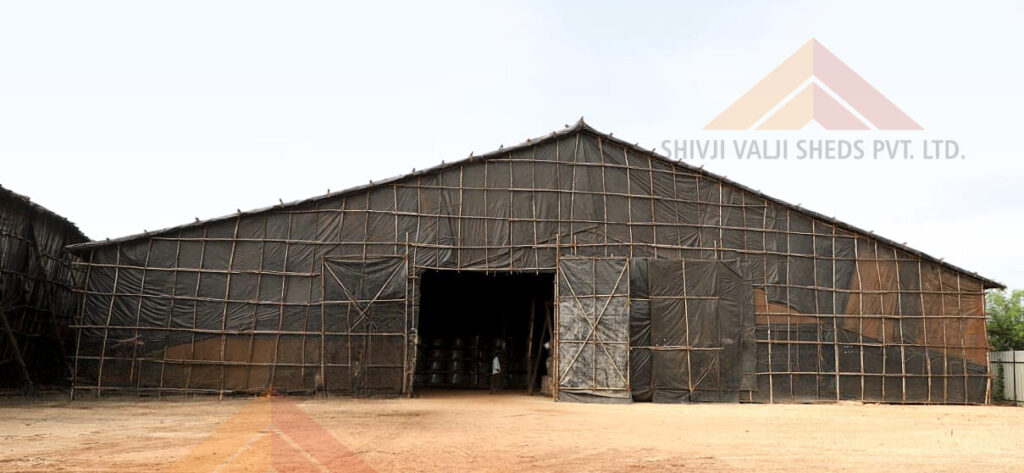
What Is a Monsoon Shed?
A monsoon shed is a temporary industrial structure built from a bamboo, wooden ballie, or MS pipe frame and covered with waterproof HDPE or PVC tarpaulin. It protects stored goods, machinery, and working areas from rain and sun for one monsoon season, then gets dismantled and removed.
The structure works on a single principle: the frame carries the load and the tarpaulin sheds the water. Neither element is permanent. No RCC foundation is cast, no steel is welded into the ground, and no part of the shed becomes a fixed asset of the building.
Defining attributes of a monsoon shed:
- Structure Class: Temporary and demountable, erected directly on the client's existing ground surface.
- Foundation: None required; frames sit on base plates, embedded ballies, or ground anchors.
- Frame Options: Bamboo and wooden ballies, MS pipe, or fabricated MS truss, selected by span.
- Roof Cover: Waterproof HDPE laminated tarpaulin, with a secondary LDPE liner at the ridge line.
- Service Life: One monsoon cycle of 4 to 6 months, renewable season after season.
- Clear Span: 6 metres for bamboo frames, extending up to 28 metres pillarless for truss frames.
- End of Contract: Dismantled, material recovered, and the site returned to its original condition.
A permanent shed reverses each of these points. Pre-engineered buildings and RCC godowns need foundations, sanctioned drawings, months of build time, and capital that stays locked in the asset. A monsoon shed converts that capital cost into a seasonal operating cost, which is why plants use it for surge storage instead of building out permanent floor area.
Wind load matters more than rain load on a temporary structure. Frame spacing, bracing, and anchoring on engineered monsoon sheds follow the wind pressure provisions of IS 875 , the Bureau of Indian Standards code for wind loads on buildings and structures. Coastal sites at Mumbai, Kandla, Chennai, and Visakhapatnam sit in higher basic wind speed zones than inland plants, so identical sheds are not specified identically across locations.
Why Is a Monsoon Shed Also Called a Tarpaulin Shed?
A monsoon shed is called a tarpaulin shed because the trade names the structure after its cover, not its frame. Tarpaulin is the visible waterproofing layer, so buyers, suppliers, and site teams use both terms to describe the same structure.
Six names circulate for one entity. Knowing which term a supplier uses prevents mis-specification at the enquiry stage.
| Term used | What it refers to | Why the name exists |
| Monsoon shed | The full structure | Named after the season it is built for |
| Tarpaulin shed | The full structure | Named after the HDPE or PVC cover |
| Rain shed / weather shed | The full structure | Named after the hazard it blocks |
| Temporary godown | The structure in a storage role | Named after the function it replaces |
| Temporary warehouse | The structure in a logistics role | Named after the function it replaces |
| Bamboo shed | The bamboo-framed variant only | Named after the frame material |
Only the last term is narrower than the rest. A bamboo shed is one type of monsoon shed, but a monsoon shed is not always a bamboo shed. Where the frame material is the deciding factor, our monsoon tarpaulin shed specification covers that variant in detail.
Types of Monsoon Sheds
Monsoon sheds divide into four types by frame system: bamboo and ballie sheds, MS pipe frame sheds, MS truss and space-frame sheds, and hybrid sheds combining steel frames with bamboo secondary members. Frame choice follows the required clear span, the equipment moving inside, and the contract duration.
Span is the first filter. A forklift aisle, a truck turning circle, or a crane path removes bamboo from consideration before cost enters the discussion.
Bamboo and Wooden Ballie Shed
Wooden ballies form the vertical posts, while bamboo rafters and purlins form the roof plane, lashed with coir rope rather than bolted. Rocket bamboo and vassa are the two grades used across Mumbai and Gujarat sites.
- Clear Span: Up to 9 metres with intermediate posts carrying the roof load.
- Erection Speed: Fastest of the four types, suited to short lead times before the rains.
- Best Suited To: Terrace storage, loading bays, small workshops, and short-duration site cover.
- Limitation: Intermediate posts obstruct forklift and vehicle movement inside the covered area.
MS Pipe Frame Shed
MS or GI pipes replace wooden posts and bamboo rafters. Members are bolted rather than lashed, so the frame is dimensionally repeatable and fully recoverable across seasons.
- Clear Span: 12 to 18 metres depending on the section and frame spacing specified.
- Erection Speed: Moderate, requiring a longer build window than a bamboo frame.
- Best Suited To: Food processing, pharmaceutical, and FMCG sites where hygiene audits restrict organic frame material.
- Limitation: Higher initial material cost than a bamboo and ballie arrangement.
MS Truss and Space-Frame Shed
Prefabricated tubular trusses are assembled at site and bolted to purlins at fixed centres, producing a rigid interlocking frame. This is the type specified when the floor has to stay completely clear.
- Clear Span: 15 to 28 metres pillarless, extending further with intermediate columns.
- Erection Speed: Slowest of the four types, requiring the longest planning window.
- Best Suited To: Cement, steel, sugar, and chemical plants with truck, forklift, and crane movement inside the cover.
- Limitation: Needs a level, load-bearing surface and a longer erection window.
Hybrid Shed
A steel primary frame carries the load while bamboo purlins carry the tarpaulin. The hybrid arrangement recovers span without the full cost of an all-steel frame.
- Clear Span: 12 to 20 metres, close to an MS pipe frame at a lower material cost. See our hybrid shed page for specifications.
- Best Suited To: Sites needing wide bays for one or two seasons only, without long-term reuse.
- Limitation: Mixed material inventory complicates dismantling and reuse across seasons.
Where the structure has to stay up beyond the monsoon and carry permanent services, the requirement has moved past a monsoon shed. That case belongs to our MS and steel shed or PEB shed category instead, both of which are built on a civil foundation and remain in position.
Materials Used in a Monsoon Shed
A monsoon shed uses four material groups: frame members of wooden ballie, bamboo, or MS pipe; waterproof covers of HDPE laminated tarpaulin or PVC-coated fabric; fixings of coir rope, GI wire, and nut-bolt assemblies; and drainage components including valley gutters and LDPE ridge liners.
Material specification decides whether a shed holds through a 200 mm rainfall day or fails at the first squall. Each group carries its own selection criteria.
Frame Materials
- Wooden Ballies: Debarked poles used as vertical posts, embedded or base-plated, carrying the axial load.
- Bamboo: Rocket bamboo and vassa grades used as rafters and purlins, selected on wall thickness and node spacing.
- MS Pipe: Mild steel or galvanised pipe sections used where bolted, reusable, and dimensionally stable frames are required.
- Fabricated MS Truss: Tubular members in structural steel grades covered by IS 2062, assembled into ground-to-ground trusses for clear-span roofs.
Covering Materials
- HDPE Laminated Tarpaulin: The standard roof and side cover, woven high-density polyethylene laminated on both faces and UV stabilised for outdoor exposure.
- LDPE Liner Sheet: A secondary low-density polyethylene layer laid at the ridge line to eliminate seam leakage.
- PVC Coated Polyester Fabric: A heavier cover specified where abrasion resistance, longer life, or fire-retardant grades are required, as used on our PVC sheds.
- Cotton Canvas Tarpaulin: A legacy cover, still used where breathability matters more than absolute waterproofing.
Cover weight is quoted in GSM. Higher GSM raises tear strength and service life, and also raises the load the frame carries, so cover and frame are specified together rather than separately.
Fixings, Anchoring & Drainage
- Coir Rope: The traditional lashing used at bamboo-to-ballie joints on conventional frames.
- GI Binding Wire: Used at cover-to-frame tie points and along overlap edges to hold the covering in position.
- Nut-Bolt Assemblies: Used on MS pipe and truss frames, allowing dismantling without cutting the members.
- Ground Anchors & Base Plates: Resist uplift, which is the dominant failure mode at high-wind coastal locations.
- Valley Gutters & Downtakes: Carry roof water to a discharge point instead of dropping it at the shed edge.
Drainage is the item most often left out of an enquiry and most often responsible for a complaint. A roof that sheds water into an unmanaged strip beside the plinth creates standing water, and standing water reaches the stock the shed was built to protect.
Uses of Monsoon Sheds Across Industries
Monsoon sheds cover open stockyards, factory yards, construction sites, ports, and agricultural storage. Cement, steel, sugar, chemical, pharmaceutical, FMCG, and food processing plants use them to hold raw material, finished goods, packaging, and machinery clear of rain between June and September.
Application follows one condition: material sits outdoors, moves too often or weighs too much to shift indoors, and loses value on contact with water.
Manufacturing & Process Plants
- Raw Material Storage
- Finished Goods Buffer
- Machinery & Equipment Cover
- Packaging Material Storage
Warehousing & Logistics
- Loading & Unloading Bays
- Temporary Godowns
- Dispatch Holding Areas
- Transit Cargo Cover
Construction & Infrastructure
- Cement & Tile Storage
- Reinforcement Steel Cover
- Shuttering & Formwork
- Site Offices & Work Areas
Stockyards & Agricultural Storage
- Steel Coils & Pipes
- Castings & Fabricated Sections
- Bagasse & Baled Produce
- Grain Bags & Jaggery
Sector rules change the specification. Food processing and pharmaceutical sites restrict organic frame material and demand a cleanable cover. Chemical plants prioritise fire-retardant grades. Cement and steel yards prioritise clear span for material handling equipment. Our temporary warehouse and storage pages set out those requirements sector by sector.
Why Choose Shivji Valji Sheds Pvt. Ltd. for Monsoon Sheds?
Every monsoon shed requirement comes with a different coverage area, site surface, and material to protect. At Shivji Valji Sheds Pvt. Ltd., we plan the frame, covering specification, and anchoring arrangement around the application rather than supplying a fixed product.
What we bring to your monsoon shed requirement:
- Contracting Since 1910: Over a century of erecting temporary structures across Indian industry, applied to how each shed is planned and executed.
- Span-Based Frame Selection: The frame system is chosen for the equipment moving inside the cover, not from a fixed catalogue of sizes.
- Wind-Load Aware Anchoring: Frame spacing, bracing, and anchoring are specified against site wind conditions rather than applied uniformly.
- Complete Erection Support: Site assessment, erection, in-season maintenance, and dismantling are handled by our own team.
- Available on Hire: Sheds can be taken for a single season, which avoids capital investment for cover that is needed temporarily.
- Phased Installation Capability: Large covers are erected bay by bay so plant operations continue during the work.
| Get a monsoon shed planned around your site, span, and season requirements Request a site survey today! |
FAQs
1. How long does a monsoon shed last?
A monsoon shed is specified for one rainy season, typically 4 to 6 months from erection to dismantling. Frames and covers in sound condition are recovered, stored, and re-erected in later seasons. HDPE tarpaulin covers are replaced sooner than frames, because UV exposure and repeated handling degrade the laminate first.
2. Is a monsoon shed fully waterproof?
The cover is waterproof, and the structure performs as waterproof when seams, ridges, and edges are detailed correctly. Leakage starts at overlaps and ridge lines rather than through the tarpaulin itself. A secondary LDPE liner at the ridge and down-slope overlaps address both failure points.
3. Does a monsoon shed need building permission?
A monsoon shed is a temporary structure without foundations, so it is not treated as permanent construction. Local authority rules still vary by city and by site classification, and plants inside notified industrial estates or port limits often run their own internal permit process. Confirm the position with your site authority before erection.
4. How long does erection of a monsoon shed take?
Erection time depends on covered area, frame type, and site access. Bamboo and ballie sheds go up fastest, while MS truss sheds take longest. Large industrial covers running into tens of thousands of square feet are phased across bays so plant operations continue during the work.
5. What is the difference between a monsoon shed and a permanent shed?
A monsoon shed is temporary, needs no foundation, is erected in days to weeks, and is dismantled after the season. A permanent shed such as a PEB or RCC structure needs foundations, sanctioned drawings, and months of construction, and stays on the books as a capital asset.