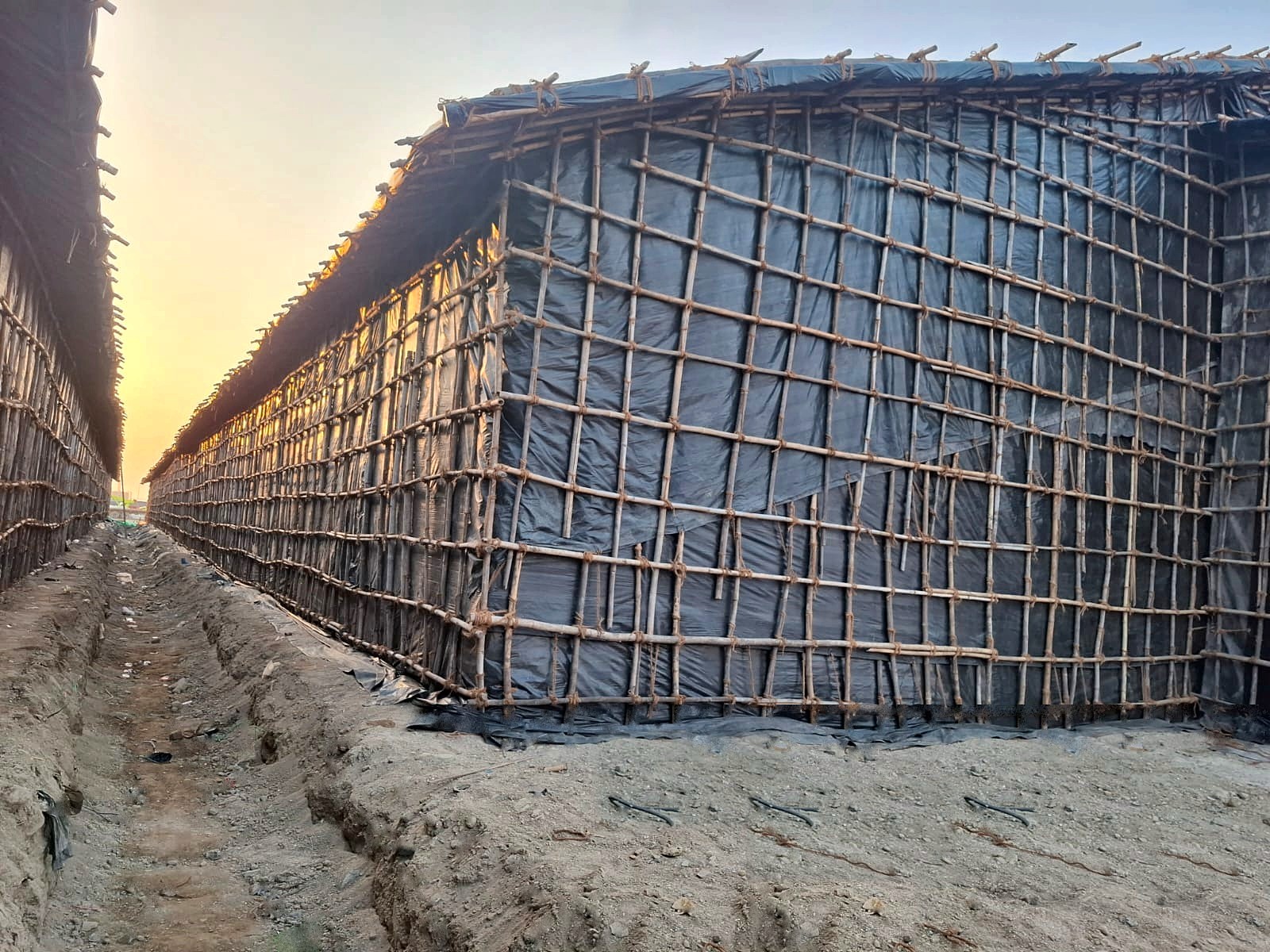
Temporary shed materials in India fall into three groups: the covering, the frame, and the fixings. If one of them is wrong, the whole shed fails. Fixings are left out of most enquiries, yet wind uplift, not rain, is the main reason temporary sheds fail. A frame chosen on price alone can rule out a forklift aisle before the first post goes up. This guide covers each material, from HDPE tarpaulin and PVC fabric to bamboo ballies, MS truss, and ground anchors, and how to match them to your span, site, and season.
Contact Us for FREE Consultation
Here's how the three material groups compare, and what each one decides for your shed.
| Material group | Common options | What it determines |
| Covering | HDPE laminated tarpaulin, PVC coated polyester, LDPE liner | Waterproofing, service life, UV resistance |
| Frame | Bamboo, wooden ballie, MS pipe, GI pipe, MS truss | Clear span, height, load capacity |
| Fixing & drainage | Coir rope, GI wire, nut-bolts, base plates, gutters | Wind stability, water discharge |
What are the Covering Materials Used in Temporary Sheds?
The most common temporary shed covering in India is HDPE laminated tarpaulin, a woven high-density polyethylene fabric laminated with LDPE film on both faces. PVC coated polyester and LDPE liner sheets are the other covers in regular use.
- HDPE Laminated Tarpaulin
The default cover across Indian industry. Woven HDPE tapes form the base fabric, laminated with LDPE film on both faces to make it waterproof. Contractors quote it by layer count, and a monsoon tarpaulin shed commonly runs from two layers on light-duty covers up to five on industrial roofs.
Weight is quoted in GSM, or grams per square metre. Indian manufacturers produce HDPE tarpaulin from roughly 68 to 500 GSM, with most industrial shed covers between 120 and 250 GSM. Test methods are referenced under IS 15351.
What GSM actually changes:
- Tear Strength: Higher GSM resists tearing at eyelets and overlaps, where covers usually fail first.
- Service Life: UV-stabilised grades last longer outdoors before the laminate degrades.
- Load on the Frame: A heavier cover adds dead load, so GSM and frame are raised together or not at all.
- PVC Coated Polyester Fabric
A polyester base fabric coated with PVC on both sides, heavier and more abrasion-resistant than HDPE. Specified where the structure stays up beyond a season, or where fire-retardant grades are required. Our PVC sheds use this material for those conditions.
- LDPE Liner Sheets
LDPE is not a primary cover. It is laid as a secondary layer along the ridge line and at critical overlaps, where seams are most likely to admit water. Cotton canvas is the one older cover still in use, chosen where stock needs to breathe.
What are the Frame and Structural Materials Used in Temporary Sheds?
Temporary shed frames in India are built from bamboo and wooden ballies, MS or GI pipe, or fabricated MS truss sections. Frame material decides the maximum clear span, so it is selected around the equipment that has to move inside the covered area rather than around cost alone.
This is the decision that closes off options later. A frame chosen on price will not carry a forklift aisle, and no cover compensates for that.
1. Bamboo and Wooden Ballies
The conventional Indian system. Teakwood or saru-grade ballies, known regionally as vassa, form the posts, while rocket bamboo forms the rafters and purlins. Members are lashed with coir rope rather than bolted, making the frame fast to erect and fast to take down.
- Typical Clear Span: Up to around 9 metres, with intermediate posts carrying the roof load.
- Best Suited To: Terrace storage, loading bays, godown covers, and short-duration site work.
- Main Limitation: Intermediate posts obstruct forklift and vehicle movement inside the covered area.
2. MS and GI Pipe
Mild steel or galvanised pipe replaces wooden posts and bamboo rafters. Members are bolted rather than lashed, so the frame can be recovered and re-erected season after season. It is also the frame used on food and pharmaceutical sites, where hygiene audits restrict organic material. See our MS and steel sheds for the specifications used.
3. Fabricated MS Truss
Tubular members assembled into ground-to-ground trusses and bolted to purlins. This is the only frame that reliably delivers a pillarless interior, which matters the moment trucks or forklifts run through the covered area. Spans of 15 to 28 metres are achievable without internal columns.
For a wide span at lower cost, a hybrid shed pairs a steel frame with bamboo purlins. Where the roof must be rigid rather than flexible, GI profile sheets replace the tarpaulin entirely.
Fixing, Anchoring and Drainage Materials
Temporary sheds are held together with coir rope on bamboo frames and nut-bolt assemblies on steel frames. Base plates and ground anchors resist wind uplift, while valley gutters carry roof water away from the structure.
This group gets left out of most enquiries and causes most of the complaints. Wind uplift, not rainfall, is the dominant failure mode on a temporary structure.
- Coir Rope: The traditional lashing at bamboo-to-ballie joints on conventional frames.
- Base Plates and Ground Anchors: Resist uplift, specified heavier on coastal sites in higher wind speed zones under IS 875 (Part 3).
- Valley Gutters and Downtakes: Carry roof water to a controlled discharge point instead of dropping it beside the plinth.
How to Choose the Right Temporary Shed Material
Temporary shed material is selected on four inputs: how long the structure stays up, the clear span required inside it, the wind exposure at the site, and any sector restrictions on frame or cover type.
Work through them in that order. Duration and span narrow the field before cost enters the conversation.
- Exposure Duration: A four-month monsoon contract and a two-year project cover are not the same specification. Longer exposure moves the cover toward PVC coated fabric.
- Clear Span Required: Measure the widest unobstructed path a forklift or truck needs. That number decides the frame, and the frame decides much of the cost.
- Site Wind Exposure: Coastal plants sit in higher wind speed zones, so identical sheds are not anchored identically across locations.
- Sector Restrictions: Food and pharmaceutical audits restrict organic frame material; chemical plants often require fire-retardant cover grades.
Our temporary warehouse and storage pages set out the specifications that suit each sector.
Why Choose Shivji Valji Sheds Pvt. Ltd. for Temporary Sheds?
Material specification is the part of a quotation most often left blank. At Shivji Valji Sheds Pvt. Ltd., we state the cover grade, frame system, and anchoring method in writing before a contract is signed.
- Contracting Since 1910: Over a century of specifying and erecting temporary structures across Indian industry.
- Written Material Specification: Cover GSM, layer count, frame section, and fixing method are stated on the quotation, not left to site.
- Span-Led Frame Selection: The frame is chosen for the equipment moving inside the cover, not from a fixed catalogue.
- Complete Erection Support: Site survey, erection, in-season maintenance, and dismantling are handled in-house.
| Get a material specification matched to your span, site, and season Request a site survey today! |
FAQs
1. Which material is best for a temporary shed in India?
There is no single best material, only a best fit for the conditions. HDPE laminated tarpaulin over a bamboo and ballie frame suits most seasonal storage. Longer exposure or wider spans move the specification toward PVC coated fabric and steel frames.
2. What GSM tarpaulin should be used for a temporary shed?
Most industrial shed covers in India fall between 120 and 250 GSM, though the manufactured range runs much wider. Higher GSM raises tear strength and service life, and also raises the load the frame carries.
3. What is the difference between HDPE and PVC tarpaulin?
HDPE tarpaulin is a woven polyethylene fabric laminated with LDPE film, lighter and more economical, and standard for seasonal covers. PVC coated polyester is heavier, more abrasion-resistant, and available in fire-retardant grades.