
Open storage is one of the most common operational risks in Indian industry. Raw materials, finished goods, machinery, and site equipment left in open plots are exposed to heavy rain, direct sunlight, dust, and wind throughout the year. Permanent construction takes months of planning, approval, and civil work, which is rarely practical when the covered space is needed for a single season or a fixed project period.
What Is a Temporary Shed?
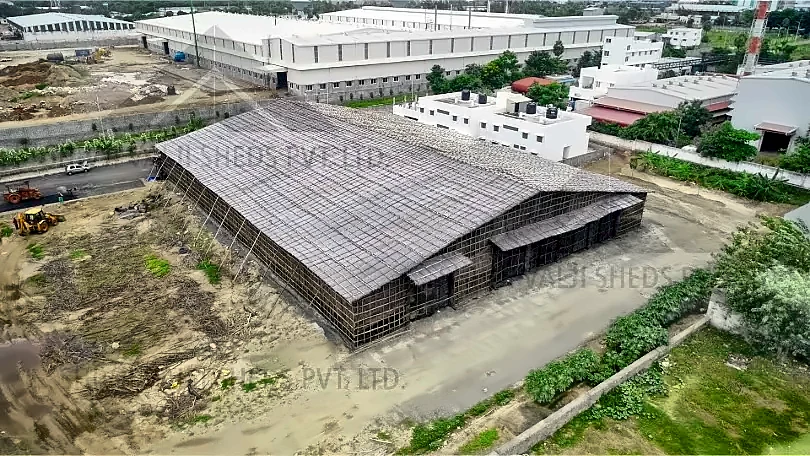
A temporary shed is a covered structure built with a lightweight framework and a flexible or sheet-based roof covering, erected on site without a permanent foundation and dismantled once the requirement ends. It creates usable covered space for storage, work, or weather protection without the civil work, approvals, and construction timelines involved in permanent buildings.
In Indian industry, temporary sheds are also referred to as monsoon sheds, rain sheds, weather sheds, tarpaulin sheds, or temporary godowns depending on the material used and the season in which they are installed. The core principle is the same in every case: covered area that can be created quickly, sized to the space available, and removed when it is no longer needed.
Temporary shed vs Permanent shed at a glance:
| Parameter | Temporary Shed | Permanent Shed |
| Foundation | No permanent foundation required | Concrete footing or slab required |
| Installation time | Days | Months |
| Roof covering | Tarpaulin, PVC, GI or LDPE sheeting | Sheeting on fixed civil structure |
| Relocation | Can be dismantled and reused | Fixed in position |
| Typical use period | Seasonal or project-based | Long-term and continuous |
| Commercial model | Available on hire or contract basis | Capital investment |
What are the Types of Temporary Sheds?
Temporary sheds are classified by the framework that carries the load and the covering fixed over it. The right type depends on the span to be covered, the height clearance needed, the site surface, and how long the structure will remain in place.
- Temporary Tarpaulin Sheds: Waterproof tarpaulin fixed over a supporting frame, widely used for open-plot storage, seasonal covered area, and temporary godowns.
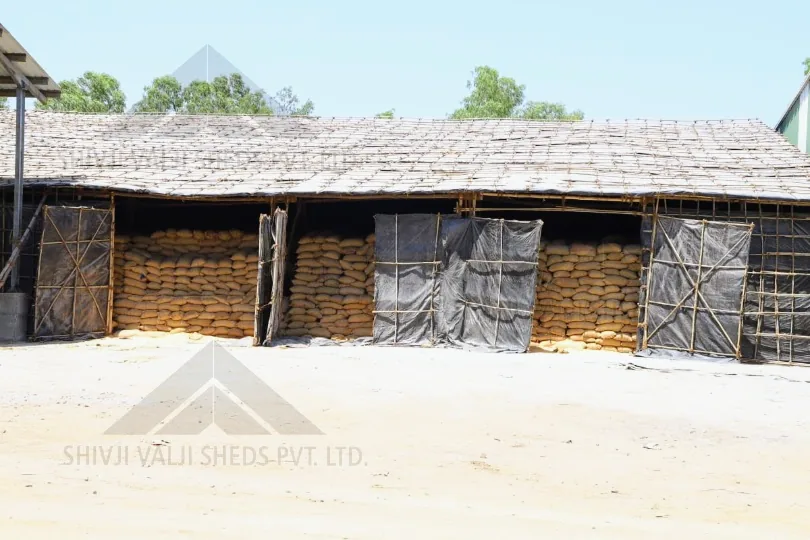
- Bamboo & Wooden Pole Sheds: A conventional Indian construction using bamboo or wooden poles as supports, suited to quick, short-duration temporary storage requirements.
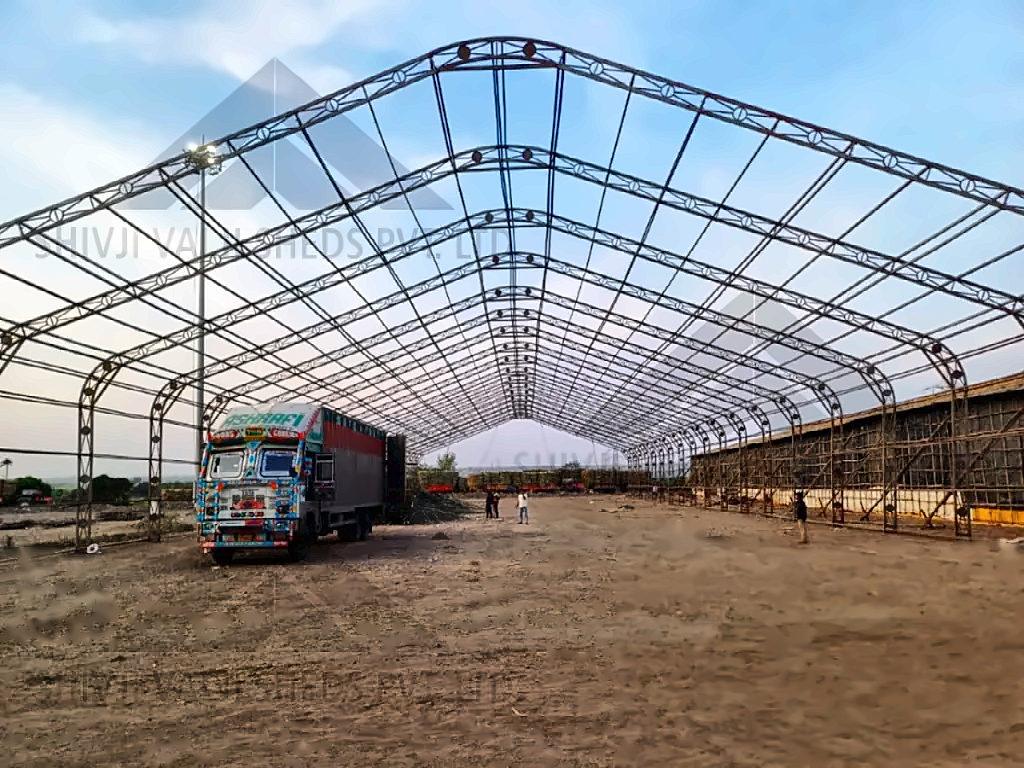
- MS Wide Span Sheds: Mild steel truss structures that create column-free covered space for bulk raw materials, finished goods, and mobile machinery.
- PVC Sheds: PVC covered structures selected where longer outdoor exposure and stronger weather resistance are needed than a standard tarpaulin covering provides.
- Dome & Pillarless Sheds: Curved dome structures that remove internal columns, allowing free movement of forklifts, trucks, and material handling equipment inside the covered area.
- German Hanger Tents: Aluminium clear-span structures available on rent, used where a large column-free covered area is required for a defined period.
- Monsoon Sheds: Monsoon tarpaulin sheds planned specifically for the rainy season, with the covering, slope, and fixing selected for continuous rainfall and wind.
- Hybrid Sheds: A combination structure that pairs steel structural strength with the cost efficiency of a temporary covering, used for bulk storage requirements.
Where the covered space is needed permanently rather than for a season or a project, businesses generally move to fixed structures such as GI sheds, PEB sheds, tin sheds, and metal and iron sheds, which are built on a civil foundation and remain in position.
Structure of a Temporary Shed
A temporary shed works as a single system in which the frame carries the load, the covering forms the weather barrier, and the fixing arrangement holds both stable against wind and rain. Each component is planned according to the span, the clearance required inside, and the conditions at the installation site.
Main structural components:
- Supporting Framework: MS trusses, GI pipes, bamboo, or wooden poles form the columns and rafters that carry the weight of the covering.
- Roof Covering: Tarpaulin, PVC sheeting, or GI profile sheets are stretched and fixed over the framework to create the weather barrier.
- Roof Slope & Drainage: A planned pitch, often in a single or two-side slope, moves rainwater off the surface instead of allowing it to collect and pool.
- Fixing & Anchoring: Ropes, clamps, bolts, and base anchoring hold the frame and covering in position during heavy rain and high wind.
- Side & Vertical Coverings: Partial or full side enclosures can be added where dust control, wind protection, or isolation of the stored material is required.
What Materials are Used in Temporary Sheds?
The performance of a temporary shed depends on the covering material and the structural components selected for the application. Specifications are planned according to the coverage area, the level of outdoor exposure, the value of the material being protected, and the expected usage duration.
- HDPE Laminated Tarpaulin: A widely used waterproof covering for monsoon and open-storage applications, available in different weights to suit exposure levels.
- PVC Coated Tarpaulin: A heavier covering option selected where longer outdoor exposure and stronger weather resistance are required.
- LDPE Sheets & Geomembranes: Used as an additional layer or ground lining where extra moisture protection or containment is needed alongside the shed.
- GI Profile Sheets: Galvanised iron sheeting used where a rigid roof surface is preferred over a flexible fabric covering.
- MS Structural Components: Trusses, pipes, and fabricated members that provide a stable framework for wide-span and pillarless structures.
- Bamboo & Wooden Poles: Conventional supports used in short-duration and cost-sensitive applications where a lightweight arrangement is suitable.
What are the Uses of Temporary Sheds Across Industries?
Temporary sheds are used wherever covered space is needed faster than permanent construction can provide it, or for a period too short to justify building. The application decides the shed type, the covering specification, and the installation method.
Manufacturing & Engineering
- Raw Material Storage
- Finished Goods Covering
- Machinery Protection
- Spares & Consumables Storage
Warehousing & Logistics
- Temporary Godowns
- Warehouse Overflow Space
- Loading & Unloading Bays
- Cargo & Transit Storage
Construction & Infrastructure
- Cement & Material Storage
- Equipment Shelters
- Building Coverings
- Site Work Areas
Ports & Bulk Material Yards
- Open Plot Covering
- Container Terminal Storage
- Bulk Cargo Protection
- Stockyard Weather Covers
Why Choose Shivji Valji Sheds Pvt. Ltd. for Temporary Sheds?
Every temporary shed requirement comes with a different coverage area, site condition, and usage period. At Shivji Valji Sheds Pvt. Ltd., we plan the framework, covering specification, and installation method around the intended application rather than supplying a fixed product.
What we bring to your temporary shed requirement:
- Over 100 Years of Shed Experience: A century of work in temporary sheds and tarpaulins across Indian industry, applied to how each structure is planned and executed.
- Application-Based Planning: The span, covering, and fixing arrangement are selected for the material being protected and the site it stands on, not from a fixed catalogue.
- Wide Coverage Capability: Structures ranging from small open-plot covers to large-span sheds of 100,000 sq ft, with capacity to plan larger areas on requirement.
- Complete Installation Support: Site assessment, erection, and dismantling are handled by our own team, so the covered space is ready without coordination across multiple vendors.
- Available on Hire or Contract: Sheds can be taken for a season or a project period, which avoids capital investment for covered space that is needed temporarily.
- Pan-India Execution Network: A partner network across Indian industrial locations allows installation at plants, project sites, ports, and warehouses outside Mumbai.
Our structures are used by manufacturers, warehouses, contractors, ports, and project sites across India that need dependable covered space for storage, expansion, and seasonal protection.
| Get a temporary shed planned around your site, material, and usage period Get in touch with our team today! |
FAQs
1. What is a temporary shed?
A temporary shed is a covered structure built with a lightweight frame and a flexible or sheet-based roof covering, installed without a permanent foundation and dismantled when it is no longer required. It is used to create covered space for storage, weather protection, and site work without permanent construction.
2. What is the difference between a temporary shed and a permanent shed?
A temporary shed is erected without a permanent foundation and can be dismantled, relocated, or reused, while a permanent shed is built on a fixed civil foundation and stays in position. Temporary sheds are installed in days rather than months and are commonly taken on hire for a season or a project period.
3. How long can a temporary shed be used?
Usage duration depends on the covering material, the framework, and the site conditions. Some temporary sheds are installed for a single monsoon season, while others remain in place across multi-year project cycles when a heavier covering and steel framework are specified.
4. What materials are used to build a temporary shed?
The covering is usually HDPE laminated tarpaulin, PVC coated tarpaulin, GI profile sheets, or LDPE sheeting. The supporting framework is built from MS trusses, GI pipes, bamboo, or wooden poles, selected according to the span and the load the structure has to carry.
5. Can a temporary shed be taken on hire in India?
Yes. Temporary sheds are commonly provided on hire or contract basis, which allows businesses to create covered space for a defined period without capital investment. Shivji Valji Sheds Pvt. Ltd. provides temporary shed installation and hire support for businesses across Mumbai and India.